RAGOS
♫
READY
RAGOS BENDING

Loading

RAGOS BENDING

Category RAGOS CNC Press Brake FAQ

Category 6. Purchasing, Technical Evaluation & Support

Q27. What information should I provide to get a press brake quotation?

To help us recommend a suitable machine, please provide the following information:

  • Material type and grade
  • Maximum material thickness
  • Required bending length
  • Workpiece drawings or photos
  • Required bend angles and flange dimensions
  • Preferred CNC controller, if any
  • Destination country or port

If you are unsure about the required tonnage or machine series, that is not a problem. RAGOS can review your application details and help identify suitable options before preparing a technical quotation.

Q28. Can RAGOS evaluate my workpiece drawings before I purchase a press brake?

Yes. Providing workpiece drawings is a useful way to assess whether a proposed press brake configuration is suitable for your application.

Where available, include the material grade, thickness, overall dimensions, flange sizes, bend angles and production requirements. Our technical team can review the information, identify key machine-selection considerations and advise on a suitable configuration. Final suitability depends on the completeness of the drawings and the technical evaluation.

Q29. Can a press brake be integrated with a robot?

Robotic integration may be suitable for applications requiring repetitive bending, high production volume or reduced manual handling. However, the robot must be selected according to workpiece dimensions, material type, weight, gripping method, cycle time and required reach.

The press brake, robot, tooling, workpiece transfer and safety system must be evaluated as one integrated application. Share your workpiece drawings and production requirements so the machine and robot configuration can be assessed together.

Q30. How can I choose the right press brake manufacturer?

Compare manufacturers based on technical suitability, machine construction, component configuration, quality-control procedures, application experience and after-sales support. Review the complete specification rather than relying on price or headline tonnage alone.

For export projects, also consider communication, spare-parts arrangements, delivery commitments and technical documentation. Request a detailed quotation and clarify any differences between the proposed configurations before making your final decision.
Category 5. Price, Configuration & International Shipping

Q21. How much does a CNC press brake cost?

The price of a CNC press brake varies according to tonnage, working length, machine series, CNC controller, number of axes, tooling and optional features. Special configurations, automation requirements and delivery terms can also affect the total investment.

To receive a meaningful quotation, specify your material, maximum thickness, bending length, preferred controller and destination country. If available, include workpiece drawings so the manufacturer can recommend an appropriate configuration rather than quoting a machine that may not suit your application.

Q22. What factors affect the price of a press brake?

Key factors include machine capacity, structural design, drive system, hydraulic components, CNC controller, backgauge configuration, crowning system, tooling and automation options. Packaging, transportation, installation and after-sales arrangements can also affect the overall project cost.

When comparing quotations, review the complete configuration and scope of supply. A lower initial price does not necessarily mean lower long-term operating costs, especially when accuracy, reliability, productivity and service requirements are important.

Q23. What is included in the standard configuration of a RAGOS press brake?

The standard configuration depends on the selected RAGOS model and the specifications stated in the quotation. Depending on the machine, the configuration may include the machine body, CNC controller, backgauge, specified tooling and other standard components.

Optional items may include alternative CNC systems, additional axes, different tooling arrangements and other application-specific features. Always refer to the model-specific technical specification and quotation for the exact scope of supply.

Q24. What is the typical delivery time for a RAGOS press brake?

As an indicative reference, RAGOS press brake lead times can range from approximately 3 to 45 working days, depending on the model, configuration, production schedule and stock availability. Special requirements may require additional production time.

The actual delivery schedule should be confirmed in the quotation or order confirmation. If your project has a fixed installation date, mention the deadline when requesting a quotation so availability and production arrangements can be evaluated early.

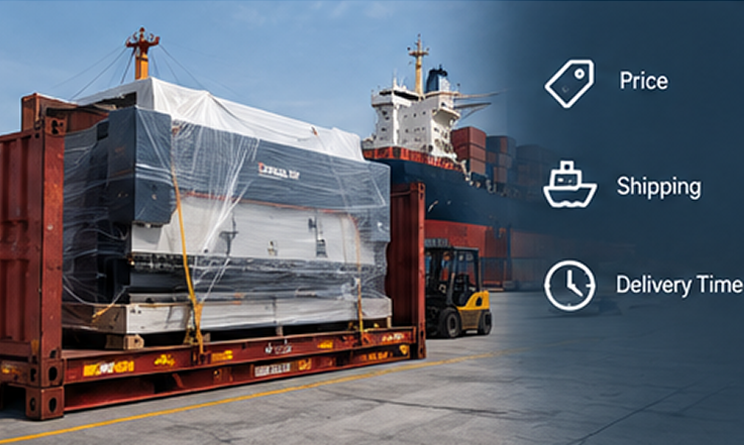
Q25. How much does it cost to ship a press brake overseas?

International shipping costs depend on the machine’s dimensions, gross weight, packaging, destination, shipping method, port charges and handling requirements. Large or heavy machines may require special loading arrangements or a specific container plan.

To obtain a freight estimate, provide the destination port or delivery address, together with the machine’s packing dimensions and gross weight when available. Also confirm whether the quotation covers export packing, inland transportation, port charges, insurance and destination-side costs.

Q26. What warranty and after-sales support should I expect from a press brake manufacturer?

Before purchasing, confirm the warranty period, covered components, technical support arrangements, spare-parts availability and any installation or training services. The exact scope can differ between suppliers and machine configurations.

International buyers should also ask how remote troubleshooting is handled, what documentation is provided and how replacement parts can be supplied. Review the warranty terms and after-sales commitments in the quotation or sales agreement before placing an order.

Category 4. Bending Accuracy, Tooling & Compensation

Q16. How accurate is a CNC press brake?

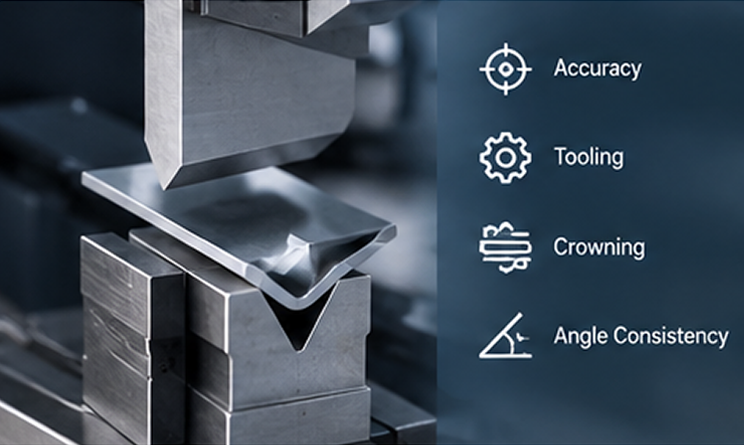
The achievable bending accuracy depends on machine rigidity, CNC control, backgauge positioning, tooling condition, material consistency and compensation settings. Positioning accuracy and finished bending-angle accuracy are different measurements and should not be treated as interchangeable.

When comparing machines, ask the manufacturer for the relevant technical specifications and test conditions. For demanding applications, testing representative workpieces using your actual material and tooling provides a more meaningful evaluation than relying on a single accuracy figure.

Q17. How can I achieve consistent bending angles?

Consistent bending angles require a combination of suitable tooling, correct machine setup, stable material properties and effective compensation. The operator must also account for springback, which varies with material type, thickness and bending conditions.

CNC programming helps maintain repeatable settings, while angle measurement or automatic angle correction can provide additional control when supported by the machine configuration. Regular calibration and consistent operating procedures are equally important.

Q18. What is mechanical crowning on a press brake?

Mechanical crowning compensates for the deflection of the machine’s ram and table under bending load. Without suitable compensation, a long workpiece may experience different bending angles near the center and at the ends.

A properly adjusted crowning system helps improve angle consistency along the bending line. Its effectiveness depends on the machine design, bending force, workpiece length and setup. Ask which compensation system is included in the proposed configuration and how it is adjusted.

Q19. How do I choose the right press brake tooling?

Tooling selection depends on material type, thickness, tensile strength, required inside radius, flange dimensions, bending method and surface-finish requirements. The punch and V-die must also be compatible with the machine and the intended bending operation.

The V-die opening affects the required force, achievable bend geometry and inside radius. Providing a workpiece drawing and material specifications helps the manufacturer recommend suitable tooling rather than relying on thickness alone.

Q20. Why does the bending angle vary along a long workpiece?

Variations in bending angle can result from ram or table deflection, insufficient or incorrect crowning, inconsistent material properties, tooling wear or an unsuitable machine setup.

Start by checking the tooling, compensation settings and material consistency. If the variation persists, assess the machine’s structural rigidity and rated capacity for the application. Long workpieces are particularly sensitive to compensation and setup, so these factors should be considered when selecting a press brake.

Category 3. Press Brake Types & CNC Controllers

Q11. What is the difference between hydraulic, hybrid and fully electric press brakes?

A conventional hydraulic press brake uses a hydraulic system to generate the force required for bending. A hybrid press brake combines hydraulic actuation with servo-driven power management, potentially improving energy efficiency and reducing unnecessary pump operation.

A fully electric press brake uses electric servo drives for its primary machine movements and does not require hydraulic oil for those movements. The most suitable type depends on required tonnage, production volume, accuracy, energy consumption and maintenance preferences.

Q12. Is a single-servo hybrid press brake suitable for thick plates?

It can be suitable if the machine’s rated tonnage, working length, tooling and configuration meet the bending requirements. The term “single-servo” describes the drive arrangement; it does not, by itself, determine the maximum material thickness the machine can bend.

For thick-plate applications, evaluate the material grade, bending length, required force and production cycle. A technical assessment is recommended before selecting a model.

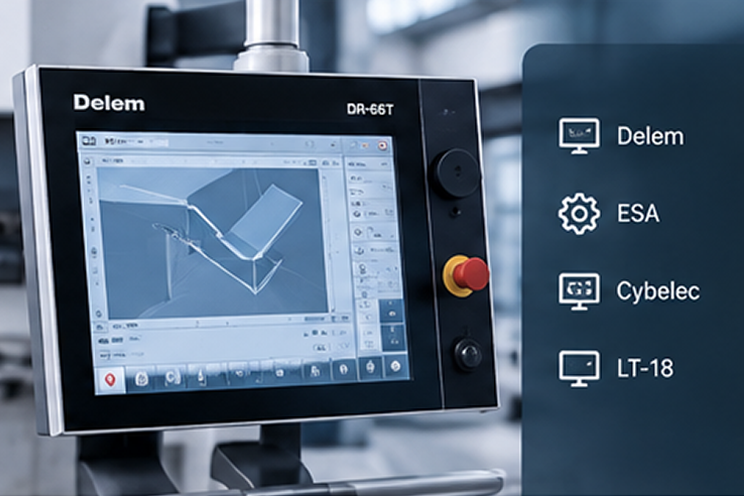
Q13. Which CNC controller should I choose: Delem, ESA, Cybelec or LT-18?

The right CNC controller depends on your programming workflow, operator experience, part complexity, required axis control and production needs. Different controller options may offer different interfaces, programming functions, graphical support and offline programming capabilities.

Before choosing, consider the types of parts you manufacture, how frequently you change jobs and whether you need 2D or 3D programming functions. RAGOS can help compare available controller configurations for the machine model you are considering.

Q14. How many CNC axes do I need for a press brake?

The required number of axes depends on part geometry, backgauge positioning, crowning requirements and production complexity. Simpler bending applications may work well with a basic configuration, while complex components may benefit from additional programmable movements.

More axes do not automatically mean better results for every workshop. The objective is to select a configuration that supports your actual parts, required repeatability and production efficiency without unnecessary complexity.

Q15. Is offline 3D programming necessary for a press brake?

Offline programming can be valuable when producing complex parts, managing frequent job changes or preparing bending programs away from the machine. Depending on the controller and software, it can help visualize bending sequences, plan setups and identify potential collisions before production.

For simple, repetitive parts, programming directly at the machine may be sufficient. Before purchasing, confirm the exact capabilities supported by the selected controller, software and machine configuration.

Category 2. Machine Dimensions & Workpiece Requirements

Q7. What press brake working length do I need for a 2.4-meter workpiece?

A press brake with a nominal working length of at least 2,400 mm is a reasonable starting point for a 2.4-meter bending application. However, the actual suitability depends on the workpiece geometry, bending sequence, tooling arrangement and required clearance.

You should also check the distance between the machine’s uprights, especially if the workpiece is wide or has a complex shape. If you expect to process longer parts in the future, a longer working length may offer greater flexibility.

Q8. What is the difference between a 2,500 mm and a 3,200 mm press brake?

The primary difference is the nominal working length. A 2,500 mm machine is intended for workpieces within its available bending length, while a 3,200 mm machine can accommodate longer bends, provided the workpiece and bending requirements remain within its rated capacity.

The choice should also account for installation space, handling requirements, production plans and budget. A longer machine is not automatically better if your workpieces are consistently shorter.

Q9. What is the distance between the uprights of a press brake?

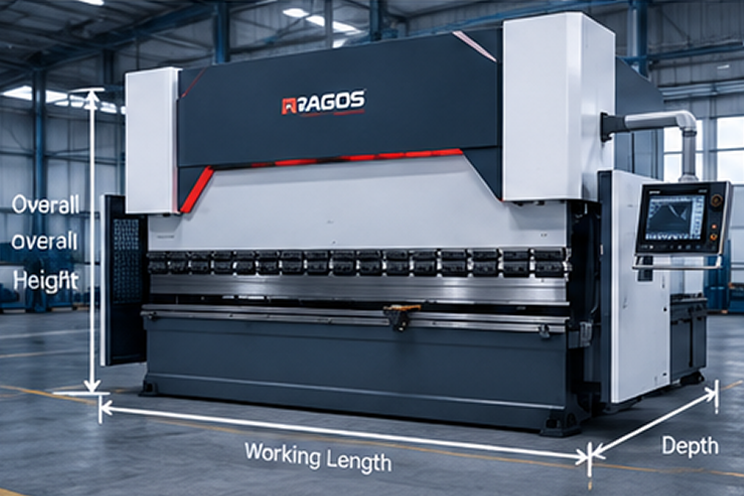
The distance between uprights is the clear horizontal space between the machine’s side frames. It is different from the nominal working length and can affect how easily certain workpieces can be positioned and bent.

For large or wide components, check both measurements before purchasing. If your application requires a minimum clear distance, specify that requirement explicitly so the manufacturer can verify the proposed machine configuration.

Q10. What machine dimensions should I check before purchasing a press brake?

Important dimensions include working length, distance between uprights, throat depth, stroke, open height, table height and overall machine footprint. These measurements affect workpiece clearance, bending flexibility and installation requirements.

For international shipments, also confirm the overall packing dimensions, gross weight, crate size and loading requirements. Providing your factory layout and largest workpiece dimensions can help identify potential installation or handling constraints before delivery.

Category 1. Press Brake Selection & Bending Capacity

Q1. How do I choose the right tonnage for a CNC press brake?

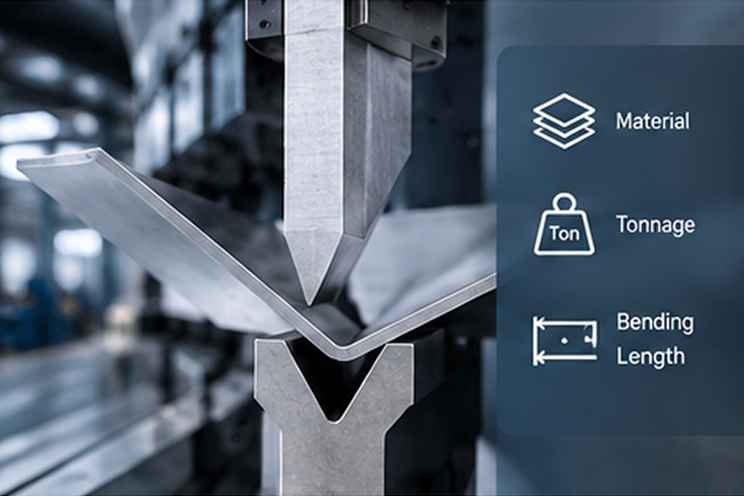
The required tonnage depends on the material type, sheet thickness, bending length, tensile strength, tooling and bending method. Thicker and stronger materials generally require greater bending force, while longer bends usually require more tonnage.

To select the right machine, consider your maximum material thickness and bending length, as well as your typical production requirements. RAGOS can evaluate your application and recommend a suitable press brake based on your workpiece specifications and technical drawings.

Q2. Can a press brake bend 8 mm steel plate?

Yes, provided the press brake has sufficient rated capacity for the material, bending length and selected tooling. However, the required tonnage for an 8 mm plate varies significantly depending on whether the bend is short or extends across a longer workpiece.

Material strength, V-die opening, flange dimensions and bending method must also be considered. Before selecting a machine, provide the material grade, plate thickness, bending length and workpiece drawing for a technical assessment.

Q3. What press brake tonnage is required for 3 mm mild steel?

The required tonnage depends primarily on the bending length, material properties and tooling. A 3 mm mild-steel sheet bent over a short section requires less force than the same material bent across a longer length.

For example, if your application involves a 2,400 mm workpiece, the machine should be evaluated for the full required bending length rather than thickness alone. Share your material specifications and drawings to determine the appropriate machine capacity.

Q4. What press brake do I need for 8 mm steel plate?

Selecting a press brake for 8 mm steel requires more information than plate thickness alone. The machine must provide sufficient tonnage and working length for the intended bends, while the tooling must be suitable for the material and required bend geometry.

The key details are material grade, maximum bending length, V-die opening, flange dimensions and production requirements. RAGOS can use these details to assess suitable machine configurations before you request a quotation.

Q5. How does bending length affect the required tonnage?

For the same material, thickness, tooling and bending method, the required bending force generally increases with bending length. This means a machine that can bend a particular thickness over a short section may not have enough capacity to bend it across the full working length.

When selecting a press brake, consider the longest bend you need to produce, not just the largest sheet dimension. The rated tonnage and working length must both match the application.

Q6. Should I choose a 130-ton or 170-ton press brake?

The decision depends on the thickest material you process, the maximum bending length, material strength, tooling and expected future production needs. A 170-ton machine offers greater nominal force capacity, but the extra capacity may not be necessary for every application.

Compare the actual bending requirements against each machine’s rated capacity and configuration. If you provide your material thickness, bending length and representative workpiece drawings, RAGOS can help evaluate which option is more appropriate.