


Category 3. Press Brake Types & CNC Controllers
Q11. What is the difference between hydraulic, hybrid and fully electric press brakes?
A conventional hydraulic press brake uses a hydraulic system to generate the force required for bending. A hybrid press brake combines hydraulic actuation with servo-driven power management, potentially improving energy efficiency and reducing unnecessary pump operation.
A fully electric press brake uses electric servo drives for its primary machine movements and does not require hydraulic oil for those movements. The most suitable type depends on required tonnage, production volume, accuracy, energy consumption and maintenance preferences.
Q12. Is a single-servo hybrid press brake suitable for thick plates?
It can be suitable if the machine’s rated tonnage, working length, tooling and configuration meet the bending requirements. The term “single-servo” describes the drive arrangement; it does not, by itself, determine the maximum material thickness the machine can bend.
For thick-plate applications, evaluate the material grade, bending length, required force and production cycle. A technical assessment is recommended before selecting a model.
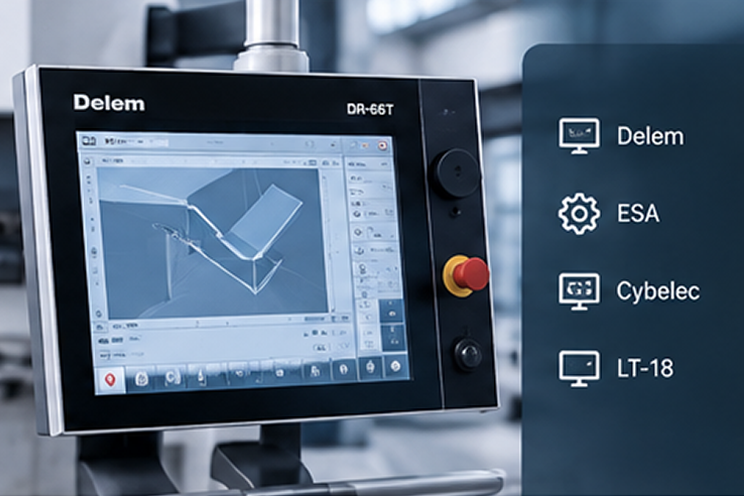
Q13. Which CNC controller should I choose: Delem, ESA, Cybelec or LT-18?
The right CNC controller depends on your programming workflow, operator experience, part complexity, required axis control and production needs. Different controller options may offer different interfaces, programming functions, graphical support and offline programming capabilities.
Before choosing, consider the types of parts you manufacture, how frequently you change jobs and whether you need 2D or 3D programming functions. RAGOS can help compare available controller configurations for the machine model you are considering.
Q14. How many CNC axes do I need for a press brake?
The required number of axes depends on part geometry, backgauge positioning, crowning requirements and production complexity. Simpler bending applications may work well with a basic configuration, while complex components may benefit from additional programmable movements.
More axes do not automatically mean better results for every workshop. The objective is to select a configuration that supports your actual parts, required repeatability and production efficiency without unnecessary complexity.
Q15. Is offline 3D programming necessary for a press brake?
Offline programming can be valuable when producing complex parts, managing frequent job changes or preparing bending programs away from the machine. Depending on the controller and software, it can help visualize bending sequences, plan setups and identify potential collisions before production.
For simple, repetitive parts, programming directly at the machine may be sufficient. Before purchasing, confirm the exact capabilities supported by the selected controller, software and machine configuration.